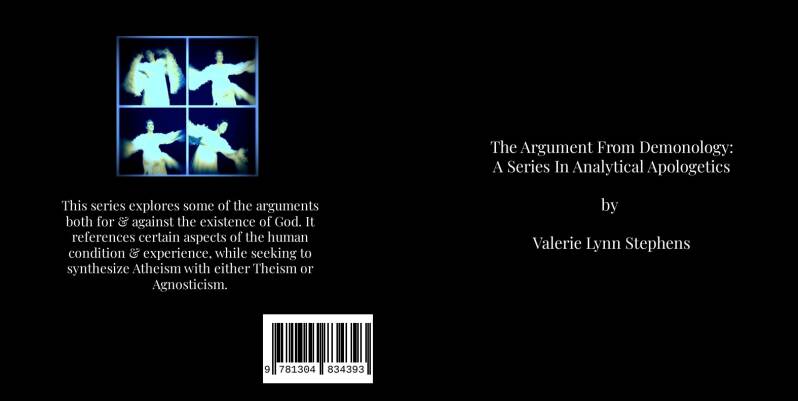
THE ARGUMENT FROM DEMONOLOGY:
A Series In Analytical Apologetics
by Valerie Lynn Stephens
All rights reserved. No part of this publication may be reproduced, stored or introduced into a retrieval system, transmitted in any form or by any means (including electronic, photocopying, mechanical, manual or otherwise) without the prior express and written consent of the owner of the copyright of this book.
©2024 Valerie Lynn Stephens
ISBN: 978-1-304-83439-3
Part One:
One would think that, all arguments exhausted, it's much more logical-not to mention ontologically efficient-to embrace a belief in a sovereign, supernatural Deity. All naturally curious & questioning human creatures must enter, at one point in their sojourn, the gates of Agnosticism. However, an exaggerated deviation & meandering into pure Atheism reveals itself, when ingenuously examined, to be utter inanity. For example, I know that I, when peering out upon the cesspool that is IN-humanity know for certain that something we have named “evil” (or at least iniquity) exists. It is readily apparent. There are no transcendentalist sentiment or gymnastics required, here. From thenceforth, is it such a stretch of the imagination to perform a “Manichean” about face towards the Holy One?
Begging the argument that perhaps all so-called “depravity” merely arises out of naturalistic human traits & strivings & yearnings, this, too, in its semantical configuration, whilst revealing itself as antinomy-is nevertheless flawed in its reductionism & assumptions. This is like speaking with one's mouth & claiming to believe with one's heart, that everything that all conscious creatures have experienced, now experience, & will someday experience arises, ex nihilo. Although I, too, undoubtedly feel the seductive pull of Nihilism's charms, as it intoxicates me so readily within its fast-acting anesthetic, I also know in that moment that I am nothing but a simpleton & a fool. For even a Physicist would agree that even so-called “nothing,” teems with “zero-point energy” something.
And herein brings us to the matter of the dark vs. the Light of the Matter. From the secular, scholarly realms of Epistemology, to Eastern mysticism & deific plurality to Western monotheism, one sentiment seems to hold sway throughout all of them: Human consciousness & comprehension is demonstrably & fallibly FINITE. I suppose this could be classified as the Argument Which Proceeds From Its Own Limits, or the Argument From Epistemology. Nevertheless, it still somehow makes its point with antinomial adequacy. This, of course, brings to reminiscence the arguments of St. Anselm & St. Augustine regarding whether or not faith is required before understanding can be breached (fides quaerens intellectum). I believe that faith is sometimes necessary for understanding, & sometimes not.
Moreover, the “head” often directly contradicts the “heart”, & vice versa. Although this by no means supports a Descartean notion of Mind-Body bifurcation & nary the twain shall meet. A synthesis of so-called “flesh” & “spirit” is absolutely not only possible, but is one of the salient features of human taxonomical individuation & authentication. One simply cannot ponder the mysteries of this universe, let alone transcend with them if one is not working to integrate ALL of one's states of experience & consciousness into a glorious union of opposites. Indeed, perhaps all “evil” truly is, can be summed up thus: That which seeks to isolate & segregate. And perhaps all “good” truly is, has already been perfected & merely seeks discovery & sanctification within its latest disciple.
But let's get back to our original exploration of the manifested contrasts of “light” vs. “dark”, & how these can actually advocate for the existence of an immaculate Deity who created all, & currently sustains all. And indeed, there are many who posit that perhaps what we call “God” in its various languages may actually be both “good” & “evil”, thereby eliminating a lot of conflict attempting to reconcile an often distressingly rigid moralistic Manichaeism in an epoch of ever-increasing human evolution & enlightenment yet psycho-spiritual entropy. We will explore these & many more fascinating inquiries in this article.
In continuum, one could argue that destructive tendencies within human beings, if a morally perfect Deity was not in operation, would have reached their critical mass of destruction long ago, & humankind would have ceased to exist. Thus, the question is: Why hasn't this happened? The main postulate of those who identify as “Atheists” is that of the mechanism of the human self-preservationary instinct. Fair enough. However, upon closer inspection, this falls flat. How can one explain then, those individuals who are operant under faulty self-preservationary mechanisms, such as those who are either actively or passively self-destructive, and/or self-neglectful? Besides, that self-same instinct is often what leads to destructive acts towards ones fellow human kin.
Next up: 'Noble Savages'-in-Recovery, Tigers & Demons-Oh, my!
Part Two:
Continuing on, many who have pondered the nature & character of God-should he indeed exist-wonder if perhaps God is not merely a more evolved, well-rounded & integrated version of both Good & Evil. Like a Nietzschean God, if you will. Furthermore, this begs the question of whether or not it is possible for a Deity to be both potentially Good &/or Evil, not unlike humans. Presupposing that this Deity is Omniscient & Omnipotent, it may be possible for it to possess both nefarious & virtuous potentialities.
However, upon further inspection, a Deity which did not exist in a state of moral & creational perfection would eventually succumb to its deleterious tendencies. And the providential graces that we see throughout our current world, would thus be immediately & disastrously, revoked. Thus, we can conclude from design, that a sovereign God, if he indeed exists, could not be both Good & Evil. As much as one mere mortal cannot serve two masters, all the same, one Immortal & Immaculate Master could not serve both Good & Evil.
Furthermore, proceeding from the premise that the presence of evil in the world strongly points towards the legitimacy of theistic claims, rather than away, let's explore this a little bit more. To start, of course, we must acknowledge the primary argument against this claim that “thanatophobia” & the self-preservationary instinct are the sole reason for humankind still remaining in existence within a relatively civil society. Fair enough. It's the perfect argument for a radicalized cynic or a misanthrope. I, myself, have oft teetered upon that edge many times throughout my life. However, even to an Atheist or an Agnostic, this explanation seems a tad reductionistic.
Furthermore, it stands to reason that there must be some 'force' of what we, in plain English call, “good”, & some 'force' which we deem “bad,” or “evil” which interplay with human 'free will' & align human cognition & behaviour along one gauntlet or another. Thus the question of provenance or origin naturally & logically follows. Although this is delving into various theories of creationism, cosmology & the like, this is relevant to our exploration of Atheism vs. Theism. It is also interesting to note, that even within some religious sects, Deism is rejected. For example, there are 'Christian Atheists' who adopts the rituals & customs of the Judeo-Christian religion, but who do not believe in Jesus Christ as the Son of God or even in God. Also, certain sects of Hinduism, Jainism & Buddhism practice atheistically based lifestyles & philosophies, as well as Humanistic Judaists.
Moreover, the argument from 'secular ethics' considers that human beings are obviously capable of engaging in prosocial & altruistic acts (or refraining from engaging in deleterious acts) in the absence of adherence to any specific religious faith or belief system. Yes. This is true. However, there is an ontological precedent that is inescapable. All human individuals, whether they call their belief system or life philosophy Islam, Buddhism, Christianity or simply, “striving to be a decent human being,” nonetheless, follow some code of ethics and/or morality. It is a built-in-feature of our very design.
In finale, it is of note that Atheists often use the “problem of evil” argument as their strongest argument when, in fact, this speculation merely seeks to cornerstone the cathedral of Theism. And when the splendid Architecture of Ultimate Reality & Truth, Absolute is viewed through the eyes of creatures who finally acknowledge their Creator, Home & Hearth cannot ever be plundered & pillaged. For this dwelling is not made of brick-and-mortar, but of the hallowed ground of a human soul justified & sanctified in Faith & Wisdom. That is to say, the problem of evil, for genuine truth seekers, is the SOLUTION to atheistic and/or agnostic leanings. Not only does suffering, depravity, injustice & darkness in this world bring us to our knees in search of deeper meaning & higher understanding, but it also, via the mechanism of Manichean mechanics, steers us towards hope, healing, righteousness, justice & the Light.
Next up, the indeterminacy of 'Scientific Determinism' & other assorted Mental Gymnasts in a dazzling display, rivaling Cirque du Soleil!........
Part Three:
In continuum, the argument from 'scientific determinism' posits that all phenomena in nature (& they would argue, in human nature) derives from purely materialistic & naturalistic (and psycho-social) causes. As another rationalizing creature, I can certainly appreciate the appeal of this worldview. After all, it stands to reason that everything contained within our Earth-and even our Universe-could merely be undergoing continual unitary transformations of flux & variation. The laws of thermodynamics & general 'physics', right? Yet upon closer inspection, questions naturally arise. The questions that are sparked include things like: “Yes, but where did all of these elements ORIGINATE FROM?” Of course, all thinkers throughout human history have explored these realms of Cosmology in each their own ways. They have all had to come to terms with the impasse of inconclusivity, as well.
At best, intellectual integrity forces those who value it to concede to the glaringly obvious & Socrates-approved conclusion that: All we know, is that we know NOTHING. Or, to put a little bit of spin on it: All that we can CURRENTLY CONCLUDE, is that we are still in the elementary stage of our psycho-spiritual & epistemological development as a species. Although some would argue that it's fair to advance us onto at least, the intermediary stage. Fair enough. I mean, we have made some strides in the Scientific & Technological arenas. The socio-political & psycho-spiritual realms are another embarrassing study in failing marks, however. All in all, what we can conclude is that even what we think we “know”, must be regarded with cautious optimism & continual humility & open-mindedness. Thus, it is fair to say that Agnosticism wins by a TKO in the pugilistic mind-game of Atheism vs. Theism.
Moreover, how does this all tie in to my premise that the existence/omnipresence of a higher Deity can be deduced from antithetical phenomena? It supports it within the negative space of the Secular Temple, wherein are placed, each according to their metaphysical dictates, Pascalian Wagers of calculated risk/benefit analyses. That is to say, the projected risk that one is taking by embracing a belief in the so-called “immaterial”, is nowhere near as potentially catastrophic as that risk exercised in the face of abject Atheism & Apostasy. Hence, many could scoff at this proposal as merely another feeble grasp at Apologetic reconciliation. Again, fair enough. But evidence of absence definitely should never preclude the conclusion that there is an absence of ANY evidence. This, in & of itself, is an established motto of the Scientific Community.
Furthermore, those who are leaning towards strict Atheism may also be quick to remind believers of the Scientific Principle of “Occam's Razor.” Occam's Razor absolutely should be applied in the case of Atheism vs. Deism. Since the principle adheres to assuming no more than is necessary, it is perfectly in line with the principle of Occam's Razor to streamline the vast complexity & diversity which one sees in the natural world (& even in the “inorganic” realms), as possessing an ontologically monistic origin. This, to all reasoning beings, is perfectly cogent & sound, rather than reductionistic. Reductionism seeks to limit. Synthesis, seeks to consolidate. In all fairness this is also an a priori or more conceptual stance, or a deductive rather than an inductive observation, but is an equally potentiated one, nevertheless. After all, the things that we experience in the so-called “material” world right now, were born from the chrysalis of an Idea, as well. Noumena can become phenomena , as we have already witnessed in many forms & variations.
In finale, whether or not we mere mortals with our grossly finite epistemological constraints, will ever be able to “prove” the existence of God, misses the mark of the mystery & challenge of Faith, altogether. God is “Spirit.” The metaphysical will never be able to be conclusively researched or “studied” in a physical laboratory. But the same could be said not long ago, of the “electron,” or the lymphocytes (hopefully copiously) circulating throughout our lymphatic systems as we speak.
Perhaps some day, should a benevolent, holy Creator decide that we have earned a peek further into the Esoteric & the Quantum “Void”, we shall be able to answer some of these inquiries with more convincing conviction to the Atheistic hangers-on. In the meantime, we shall continue our humble & sincere exploration into more Apologetics Mind-Scapes.
Next up, Satan, Legion, Belial, Abaddon & other assorted abyss-mal characters in the Ultimate Campaign against God & Man rivaling any invention of Gygax & Arneson!
Part Four:
As far as those who choose to believe in entities such as “demons” & “angels”, etc., we shall briefly touch upon their theorized substance & origin. The Judeo-Christian Scriptures do not mention many demonic spirit beings by name. Some of those that are explicitly mentioned are: Belial, Beelzebul/Beelzebub, Abaddon, Legion, Azazel & , of course, Satan. Being that it is not the aim of this article to systematize all of the varieties of spirit beings in the whole annals of human experience & imaginings, I shall move into the next section.
While some theorize that spirit beings are completely beyond human understanding & trying to study them is probably an exercise in futility, there are others who enjoy the process of inquiry nevertheless. I suppose that I fall neither too far to the right or the left on that spectrum of intellectual curiosity. I do see the value in theorizing about their origins & even composition, although I believe that we shouldn't spend too much of our precious & limited time upon this earth exploring this subject.
Furthermore, I am of the tendency to merely categorize “spirit beings” (including God) into the category of noumenon. Immanuel Kant was the first recorded philosopher to expound upon this aspect of the human experience. He posited that there are some things beyond perfect human understanding, & I definitely agree with the common sense inherent in this argument. In summary, the “thing-in-itself” (German: “Ding an sich”), is a pure form disambiguated from phenomenal experience or perception of said “thing.” This appears to be readily apparent-at least to those who are exercising intellectual integrity & humility.
Moreover, the realm of quantum physics seems the most promising to me as far the subject of deities, demons, angels & the like, goes. Put simply, what the esoterically-inclined refer to as the metaphysical realms, could merely be subatomic phenomena manifesting itself on a level beyond the “Planck length” that we cannot directly observe. That is to say, perhaps they do actually exist in a very real, 'physical' sense & we just do not have the 'tools' to observe & study them with.
It could also be theorized that what physicists, astronomers & the like refer to as “dark matter”, & “dark energy”, could also play a part in the role of spiritual and/or religious phenomena. That is why perhaps, we intuitively refer to these things as “principalities”, “powers”, & “forces.”
Moreover, perhaps what Christians call “Heaven” & “Hell”, is not so far off from the Copenhagen Many Worlds Interpretation, first posited in 1957 by physicist Hugh Everett. In addition, perhaps the “new earth” & the “new heavens” spoken of in Judeo-Christian Eschatology, are being created as we speak according to Hubble's Constant/Universal Expansion, & the general laws of thermodynamic entropy. And although these parallelisms & metaphors may be deductive & currently conceptual, they are reasonable possibilities.
In finale, Theism is not really all that far-fetched in light of all other inventions of human consciousness. Indeed, the argument from 'demonology' or the argument from 'Good vs. Evil', may not be as flimsy in the face of human ontological & existential tumult. As explored before in Parts One & Two, an omnipotent Deity could not possess both 'holy' & 'evil' tendencies due to the very essence of both being absolute. One cannot serve two masters, when said Deity was tapping into their 'evil' nature, it could not result in anything less than a complete negation/annihilation of its 'opposite.' That's just how it works in the realm of the Categorical Imperative & Onto-LOGIC.
Atheism, on the other hand, engages on the positive atheistic end of the spectrum, in arrogance & cerebral tomfoolery. On the negative atheistic end, it engages in cerebral slothery & negligent indifference. Agnosticism remains for lapsed and/or inactivated disciples of theistic faith, the honest option.
Next up, the 'Deadly Sins', & their saintly Sister Twins: Sanctification & Mortal Transcendence.
Part Five:
In the belief systems of many religions, Soteriology is the study of salvation, namely by which means one can achieve eternal life, or entrance into a Utopian afterlife. In Buddhist belief, “dukkha” (suffering) can be ended by shaking off the burden of “samsara” or continuous rebirth & obtaining “nirvana”, which is a state of mindly freedom & neutrality. This is believed to be obtained through daily practices of transcendental meditation & asceticism. Likewise, Taoists believe that “salvation” can be obtained via the process of enlightenment. Thus, what some Judeo-Christians refer to as “original sin” & “depravity”, most Buddhists believe to be a result of a grasping at the “maya” or illusions of mindly & fleshly desire & pining.
In Judeo-Christianity, it is believed that only by believing in the life, death & resurrection of Jesus Christ (the Son of God sent as a final atonement for humankind), can one be “justified” (atonement by proxy of Jesus Christ) & become “sanctified” (conformed into the image of Christ & God) through the power of “the Holy Spirit's” work within the heart & mind of the adherent as they strive to maintain their Christian discipleship throughout their life. Obedience & surrender are a requirement to obtain a Heavenly & “new earth” entrance in the afterlife. The orthopraxis of Judeo-Christianity varies from denomination to denomination. Yet a few key beliefs & rituals are shared amongst them. The main being, of course, daily prayer & worship.
In Hinduism, as well as Sikhism, Jainism & Buddhism, what is referred to as “moksha” (also called vimoksha, vimukti & mukti) is a transcendent state of liberation & ultimate “kaivalya” (the term “nirvana” can also be substituted), from “samsara” (rebirth) & suffering. This state is striven for through a study & adherence to the “Vedas”, the “Tantras”, “Upanishads”, “Puranas” & other sacred texts of Hinduism. Hinduists, not unlike Buddhists, also do not believe in human depravity, per se, rather they believe in a world of false illusions & temptations inflicting the psycho-spiritual dissonance within humanity, and that to free oneself from them should be the ultimate goal.
In Sikhism, meditation upon the Naam Japo (their God & his message) is practiced in order to achieve salvation. Further, thoughts & deeds can become “nirmal” (pure) through a practice of detachment from the things of this world & from the goadings of selfish & egoistic pride & the flesh. It is believed that once a human soul has achieved this, they can merge with God. In Islam, the depravity of man is implicitly & explicitly embraced. The only way to achieve salvation for those of the Muslim faith, is through daily & even hourly repentance before God, & strict self-accountability & discipline.
Moreover, in the Shinto & Tenrikyo faiths, one can strive for salvation by doing virtuous deeds & working to resist one's deleterious & nefarious inclinations. In Judaism, much like in Islam (although Muslims believe in an paradisaical afterlife called “Jannah”) and Judaists do not, salvation can be sought through legalistic means. They practice a stringent adherence to holy commands & scriptures (the “Torah”), which were given by Moses on Mount Sinai. The Judaist's version of “salvation” differs from that of Christianity. They look at it more as a final “redemption” or resting place from continual earthly exile. These are some of the soteriological beliefs from the major religions of the world.
Next, we shall summarily explore the problem of human depravity & how each branch of Atheism both supports & refutes Theism based upon this premise.
First, we have the “positive atheists.” The positive atheists set out to more actively (and even aggressively prove that God does not exist.) The negative atheists are usually indifferent to the issue one way or another, if they have even thought about it at all. They are perhaps, latent Agnostics. When exploring soteriology & the study of evil & sin, etc., the positive atheists & the atheistic & inductive naturalists would most likely defer to the natural world or Science (as well as Scientism) & Sociology, Anthropology & Psychology to explain not only the lack of the need for God's existence or the depravity of humankind, rather than religion or spirituality. This is a fair & reasonable deduction.
However, the main problem with this belief is the question of transcendence. In a word, how, if humanity is so finite & so fragile of a species, do individuals within that taxonomy ever manage to rise above their own depravity? One view is, of course, in line with what most positive atheists would prescribe, that it is quite simple just a matter of will. Humans can, if we will it strongly enough, achieve a sort of self-salvation. But, is this really salvation, considering the readily apparent fact that we continue to be blunder & behave in deplorable ways even afterwards? Thus, perhaps it is more accurate to call it a temporary abatement, rather than transcendence.
Moreover, particularly in the Judeo-Christian faith, human frailty & self-INsufficiency are stressed when dealing with how exactly one can overcome one's depraved nature. Of course, the Atheists would argue that humankind doesn't really NEED to overcome its baser nature in order to live a relatively good life. Yet this does fly in the face of common wisdom. Ancient Greek philosopher Epicurus expounded upon this a little. He proposed that happiness or contentment is found not through wanton indulgence in every possible pleasure but rather, a curated compendium of only those pursuits which are both naturally aligned with long-term euthumia, & which promote the development of higher virtues & self-mastery.
Furthermore, I suppose this does suggest that human free will is often somewhat sufficient in obtaining temporal states of rectitude. Also, there is still the reasonable argument that fear of consequence (possible lethal) is also another way that human beings are able to resist their depravity & destructive impulses. As someone once remarked: “Fear keeps us sane.” These are all very valid possibilities in answer to the inquiry of soteriology. I suppose I could make a mere deductive & conceptual argument in opposition to it. Perhaps it is perfectly sound to accept that individual persons can disbelieve in any kind of theistic adherence & still manage life relatively well.
However, even conventional wisdom & even the social sciences would find it more reasonable to live a life of moral & ethical integrity. Even in the absence of any 'religious' assumptions related to loftier reasons for doing so, the mere regulation of one's thymic cycles, self-preservation, thrivance & well-being are perfectly reasonable. And perhaps, once one has begun practicing moral integrity & reaps those rewards, they may find themselves slowly opening to more mystical & maybe even ecclesiastic pursuits. In the end, both Atheism & Theism are both logically reasonable stances to take. I suppose then the question is: Which one is the most OPTIMAL?
In finale, does God exist & if so, how can we 'know' for sure?
Judeo-Christian Scripture states that, should anyone gaze directly upon or come fully into the physical presence of God, they will not live. That's because God is pure energy/Spirit. It would be similar to being irradiated & most probably undergoing some kind of spontaneous evaporation. God exists in such a purified physical & spiritual form, & vibrates at such a high frequency, that no mere mortal could survive being in His full presence.
We will never be able to 'prove' anything spiritual like we can prove that the Legionella bacteria exists. This is not only due to the Heisenbergian Uncertainty Principle when dealing with subatomic phenomena, but also due to lacking the necessary Laws of Physics & tools within our current incarnation & epoch, to measure them with. Thus, the follower of what is called “atheistic noncognitivism” would tout this view. They believe that such an inquiry is futile from an empirical standpoint & thus should not be explored.
Nevertheless, this should not hermetically seal off any areas of the so-called 'Esoteric' & 'immaterial' for continual exploration. After all, perhaps God does exist on some actual 'physical' level. Perhaps we merely do not possess the current physiology and neuro-anatomy with which to fully know Him. Until such day, humanity will have to settle for the abstract & the numinous. And from my experience, that's definitely not such a bad deal. Without a little mystery, life would simply become unbearable.
And even from an atheistic standpoint, life is what we make of it. And there is simply no need to make of it, a living Gehenna beyond what is necessary. While the aim of this series has not been to 'prove' anything beyond the shadow of a doubt, I hope that I have at least touched upon some of the salient features of human existentialia & their relevance regarding the continued search for higher wisdom & Truth. And hopefully, each & every human individual shall someday breach the light of Faith & Reason, at last existing in a state of antinomial synthesis with more & more laser-point precision as one continues towards it. But until then, may our species heed the immortal words of Jack Kerouac: “All is well. Practice kindness. Heaven is nigh.”
Thanks for reading & Godspeed.
For a more immersive Audio-Visual experience, go to:
https://www.patreon.com/posts/argument-from-in-94787725
To purchase a good old-fashioned "hard-copy", visit:
Or...to access for your leisurely perusal at no cost in line with my values that all Art should be made universally available, visit here:
Add comment
Comments